Thursday, 29 November 2012

Jupiter (Planet) - November 22, 2012

Fifth planet from the Sun and the largest planet in the solar system. The fourth brightest object in Earth’s sky, after the Sun, the Moon, and Venus, Jupiter is more than three times brighter than Sirius, the brightest star. Due to its prominence in the sky, the Romans named the planet for their chief god, Jupiter.

Jupiter orbits the Sun at an average distance of 778 million km (484 million mi), which is about five times the distance from Earth to the Sun. Jupiter’s year, or the time it takes to complete an orbit about the Sun, is 11.9 Earth years, and its day, or the time it takes to rotate on its axis, is about 9.9 hours, less than half an Earth day.

Unlike the rocky inner planets of the solar system (Mercury, Venus, Earth, and Mars), Jupiter is a ball of dense gas and has no solid surface. Jupiter may have a core composed of rock-forming minerals like those trapped in comet ices, but the core makes up less than 5 percent of the planet’s mass. The force of gravity at the level of the highest clouds in Jupiter’s atmosphere is about 2.5 times the force of gravity at Earth’s surface.

Gas and clouds in Jupiter’s atmosphere travel at high speeds. This phenomenon is not fully understood but it is related to the planet’s high rate of rotation. These gases and clouds travel faster at the equator than at higher latitudes. The gases and clouds of the atmosphere are thrown outward as the planet rotates, similar to the manner in which mud is thrown outward from a spinning wheel. The balance between gravity and this outward force, which is proportional to the rotational speed of the atmosphere, noticeably distorts the planet’s round shape. Higher speed at the equator produces greater outward force, causing an equatorial bulge, whereas lower speed at the poles gives gravity the edge, leading to polar flattening. Jupiter’s equatorial diameter is 143,000 km (89,000 mi), 6.5 percent larger than the polar diameter of 133,700 km (83,000 mi).

Jupiter - the fifth planet from the sun.

Mars (Planet) - November 21, 2012

Fourth planet in distance from the Sun in the solar system. Mars is of special scientific interest because of its similarities to Earth. It has an atmosphere with seasons and changing weather, and its surface shows evidence of ancient water and volcanoes. The length of its day and the tilt of its axis are similar to those of Earth. Mars takes about two years to circle the Sun at an average distance of 228 million km (141.7 million mi). The possibility of life on Mars, now or in the distant past, is one of the major questions in astronomy. More space probes have been sent to Mars than to any other planet. Mars is named for the Roman god of war. It is sometimes called the red planet because it appears fiery red in Earth’s night sky, the result of rusty, iron-oxide mineral dust that covers its surface.

Mars is a relatively small planet, with a diameter of about 6,794 km (4,222 mi) or about half the diameter of Earth. Mars has about one-tenth Earth’s mass. The force of gravity on the surface of Mars is about three-eighths of that on Earth. Mars has twice the diameter and twice the surface gravity of Earth’s Moon. The surface area of Mars is almost exactly the same as the surface area of the dry land on Earth. Mars is believed to be about the same age as Earth, having formed from the same spinning, condensing cloud of gas and dust that formed the Sun and the other planets about 4.6 billion years ago.

Mars has two moons, Phobos and Deimos, which are named after the sons of the Roman god Mars. These tiny bodies are heavily cratered, dark chunks of rock and may be asteroids captured by the gravitational pull of Mars. Phobos orbits Mars once in less than one Martian day, so it appears to rise in the west and set in the east, usually twice each day. Deimos has the more ordinary habit of rising in the east and setting in the west.

Mars - the fourth planet from the sun.

Earth (Planet) - November 20, 2012

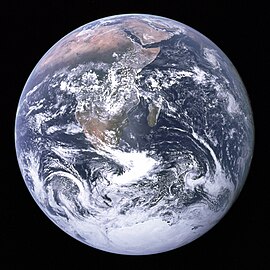
Third planet in distance from the Sun in the solar system, the only planet known to harbor life, and the “home” of human beings. From space Earth resembles a big blue marble with swirling white clouds floating above blue oceans. About 71 percent of Earth’s surface is covered by water, which is essential to life. The rest is land, mostly in the form of continents that rise above the oceans.

Earth’s surface is surrounded by a layer of gases known as the atmosphere, which extends upward from the surface, slowly thinning out into space. Below the surface is a hot interior of rocky material and two core layers composed of the metals nickel and iron in solid and liquid form.

Unlike the other planets, Earth has a unique set of characteristics ideally suited to supporting life as we know it. It is neither too hot, like Mercury, the closest planet to the Sun, nor too cold, like distant Mars and the even more distant outer planets—Jupiter, Saturn, Uranus, Neptune, and the tiny dwarf planet Pluto. Earth’s atmosphere includes just the right amount of gases that trap heat from the Sun, resulting in a moderate climate suitable for water to exist in liquid form. The atmosphere also helps block radiation from the Sun that would be harmful to life. Earth’s atmosphere distinguishes it from the planet Venus, which is otherwise much like Earth. Venus is about the same size and mass as Earth and is also neither too near nor too far from the Sun. But because Venus has too much heat-trapping carbon dioxide in its atmosphere, its surface is extremely hot—462°C (864°F)—hot enough to melt lead and too hot for life to exist.

Although Earth is the only planet known to have life, scientists do not rule out the possibility that life may once have existed on other planets or their moons, or may exist today in primitive form. Mars, for example, has many features that resemble river channels, indicating that liquid water once flowed on its surface. If so, life may also have evolved there, and evidence for it may one day be found in fossil form. Water still exists on Mars, but it is frozen in polar ice caps, in permafrost, and possibly in rocks below the surface.

For thousands of years, human beings could only wonder about Earth and the other observable planets in the solar system. Many early ideas—for example, that the Earth was a sphere and that it traveled around the Sun—were based on brilliant reasoning. However, it was only with the development of the scientific method and scientific instruments, especially in the 18th and 19th centuries, that humans began to gather data that could be used to verify theories about Earth and the rest of the solar system. By studying fossils found in rock layers, for example, scientists realized that the Earth was much older than previously believed. And with the use of telescopes, new planets such as Uranus, Neptune, and Pluto were discovered.
In the second half of the 20th century, more advances in the study of Earth and the solar system occurred due to the development of rockets that could send spacecraft beyond Earth. Human beings were able to study and observe Earth from space with satellites equipped with scientific instruments. Astronauts landed on the Moon and gathered ancient rocks that revealed much about the early solar system. During this remarkable advancement in human history, humans also sent unmanned spacecraft to the other planets and their moons. Spacecraft have now visited all of the planets except Pluto, now classified as a dwarf planet. The study of other planets and moons has provided new insights about Earth, just as the study of the Sun and other stars like it has helped shape new theories about how Earth and the rest of the solar system formed.

As a result of this recent space exploration, we now know that Earth is one of the most geologically active of all the planets and moons in the solar system. Earth is constantly changing. Over long periods of time land is built up and worn away, oceans are formed and re-formed, and continents move around, break up, and merge.

Life itself contributes to changes on Earth, especially in the way living things can alter Earth’s atmosphere. For example, Earth at one time had the same amount of carbon dioxide in its atmosphere as Venus now has, but early forms of life helped remove this carbon dioxide over millions of years. These life forms also added oxygen to Earth’s atmosphere and made it possible for animal life to evolve on land.

A variety of scientific fields have broadened our knowledge about Earth, including biogeography, climatology, geology, geophysics, hydrology, meteorology, oceanography, and zoogeography. Collectively, these fields are known as Earth science. By studying Earth’s atmosphere, its surface, and its interior and by studying the Sun and the rest of the solar system, scientists have learned much about how Earth came into existence, how it changed, and why it continues to change.

Earth - the third planet from the sun.

Venus (Planet) - November 19, 2012

Second planet in distance from the Sun, but the hottest planet in the solar system (hotter than Mercury). Its hellish surface has broiling temperatures that make rocks glow red under a crushing atmosphere that shrouds the planet in thick layers of clouds. Venus is nearly the same size as Earth, but takes 243 days to rotate on its axis in the opposite direction. It also lacks a magnetic field and a moon. Why conditions on Venus and Earth are so different remains a major puzzle for planetary scientists. Venus circles the Sun at a distance of 108 million km (67 million mi) in a little over seven months (about 225 days). The planet was named for Venus, the Roman goddess of beauty.


Except for the Sun and the Moon, Venus is the brightest object in the sky. It is often called the morning star when it appears in the east at sunrise, and the evening star when it is in the west at sunset. In ancient times the evening star was called Hesperus and the morning star Phosphorus, Eosphoros, or Lucifer.  I find astronomy a fascinating science…you learn incredible new things from each studied planet…such as in this case Venus!!

Venus - the second closest planet to the sun.

Mercury (Planet) - November 18, 2012

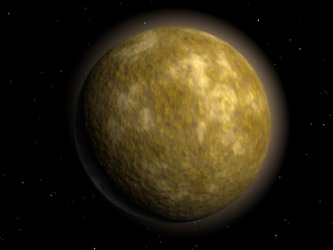
First planet in distance from the Sun in the solar system. The smallest of the rocky or terrestrial planets that include Venus, Earth, and Mars, Mercury has a global magnetic field, but only a trace of an atmosphere and no moons of its own. It is the second hottest planet after Venus. Mercury circles the Sun every 88 Earth days at an average distance of 58 million km (36 million mi) and takes 59 days to turns on its axis. It retains an ancient cratered surface that has changed little since the formation of the solar system, making the planet of special interest to planetary scientists. Mercury was named for the fleet-footed messenger of the gods in Roman mythology.

Mercury’s diameter is 4,879 km (3,032 mi), about 40 percent the diameter of Earth or about 40 percent wider than the Moon. Mercury’s volume and mass are about one-eighteenth that of Earth. Mercury’s mean density, 5.4 g/cm³, is nearly as great as that of Earth and is higher than that of any of the other planets. The force of gravity on the planet’s surface is about one-third of that on Earth’s surface or about twice the surface gravity on the Moon and about the same as the surface gravity on Mars, which is larger than Mercury but less dense. Two moons in the solar system—Jupiter’s Ganymede and Saturn’s Titan—are also larger than Mercury but are much less dense and hence have lower gravity (about the same as the Moon).  I find mercury a fascinating planet, it is so small, yet quite a monstrosity in relation to the secrets it holds of the universe.

Mercury - the closest planet to the sun.

Military - November 17, 2012

One of Canada’s greatest prides is her armed forces.  The men, and women who sacrifice their time, effort, and sometimes lives are a great inspiration to us Canadians.  They give of themselves wholeheartedly and we must admire their strength, and courage, supporting them at all times.  My interest in commending, and supporting our troops was initially engaged by a close friend, and classmate of mine.  One day, Theo A. and I were conversing on future career paths, and that is when he unravelled his dream of joining the military. 

The armed forces provide amazing opportunities to youth.  They give one the chance of a fully paid college or university education, and then afterwards a fully paid job.  The army develops your fitness, discipline, and endurance.  Also, one doesn’t have to always fight…there is a lot of free time, as well as placement opportunities with the corps of engineers.  So if one is ever in need, the armed forces are ready, willing, and waiting. 

Computer Science - November 16, 2012

Of all my courses this semester computer science is my favourite.  I enjoy creating programs using Visual Basic 2008.  I find that object-oriented programming is very easy to learn and apply.  In the past couple months I have transitioned from a rookie who had limited knowledge on how computers worked into an ample student who can create an adequate application.  Many of my peers also enjoy the course.  They find the method of teaching fun and very engaging.  I hope I will continue to do well in this course…(I’ll keep my fingers crossed).